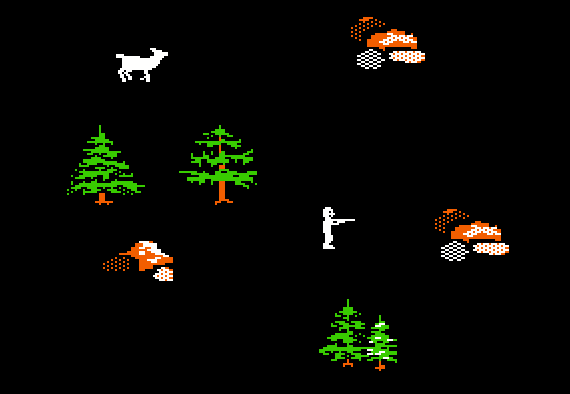
When I was younger, I used to go on hour long runs around the neighborhood. My general strategy was to run as far away from my house as possible to force myself to drag myself back home. I run West Marches hex crawls the same way. I want my players to sally forth—perhaps a bit recklessly—into the fog of war, learn what’s out there, and drag themselves back to town in the nick of time. Although I know that rations can be a useful tool for giving players agency and establishing stakes in a hex crawl environment, they always seem to fall short of their promise at my table. When players inevitably run out of rations (mostly because spoliation limits the number of rations players can bring), I feel like we get bogged down with hunting minigames. Hunting may have been the highlight of playing The Oregon Trail, but in a West Marches campaign it’s pretty onerous for my tastes. The likelihood of finding food is always low, the amount they find is generally meager, and the danger is generally low because I don’t want to TPK over expired/depleted rations. If I’m going to spend an afternoon immersing myself in a fantasy world with my friends, I don’t want to waste time doing mundane tasks like hunting. Yet, I also want rations to matter. Can I have my cake and eat it too? Or is that asking too much when rations are already spread thin at my table?
While I will be the first to admit that the problem may lie in me, I do think there is room for further innovation in the way the OSR community thinks about rations and hunting.
And so, I want to propose a new means of tracking rations. My approach draws upon the resource die popularized by Forbidden Lands, as well as Ten Foot Polemic’s advice to give food an active use. My approach also offers another way of integrating hirelings into a campaign.
Establishing Design Philosophy and Terms
Anne of DIY & Dragons has been instrumental in shaping my general design philosophy for resource management. She writes, “If resource management is going to matter, then the rules for resources have to be simple enough to remember, monitor, and apply at the table.” And so, while other designers have promoted plenty of approaches for hex crawling, I want to keep things as simple as possible. For me, a hex crawl is meant to provide players with a dynamic sandbox to explore things. I don’t hex crawl to simulate camping. I use hex crawling as a give players a sense of direction and flesh out the world they play in. While some procedure is always necessary, I want to minimize it in such as way that there is more emphasis on the adventure of discovering locations, relics, and personalities.
For those of you who are not familiar with Forbidden Lands‘s resource die, it’s a method of tracking consumable items using D6 through D12. Whenever your character uses a consumable item you roll the resource die. When you roll a 1-2 the resource die’s value drops on the dice chain (e.g., from D8 to D6). If you roll a 1-2 with a D6 resource die you are effectively out of that item. This mechanic is easily one of the most elegant solutions devised in modern TTRPGs. Although Forbidden Lands offers a means of increasing one’s resource die through hunting and foraging rules, that’s a little too crunchy for the campaign I’m trying to run.
Ten Foot Polemic distinguishes between resources that are either “drained” or “used up.” Rations are usually drained, whereas items like treasure maps are used. In short, players need to exert agency to gain benefit from resources that are used. Ten Foot Polemic’s solution is to give food an active use for healing (whether in a dungeon or overnight). That is to say, if your character goes to bed hungry, they are not going to heal their wounds. I like this a lot since it addresses a recurring problem in my West Marches hex crawl campaign, which runs on Dungeon Crawl Classics. In DCC, characters may recover one HP and/or ability score each night. This slow burn approach to healing is meant to keep characters a little vulnerable and players hesitant to burn ability scores in every combat situation. Since my players often travel many days without a combat encounter, this vulnerability is sharply curtailed.
I should also note that my players frequently have encounters, they just aren’t always combat related. Sometimes they just stumble upon interesting situations. For instance, they might find:
- Monster (whether wandering, footprints/spoor, or their lair)
- Random people
- Traps/hazards
- Weather events
- Surreal Occurrences
While I’ve subsequently found other creators offering similar advice on how to design a hex crawl encounter, Daniel Norton’s video detailing different types of encounters was highly influential for me.
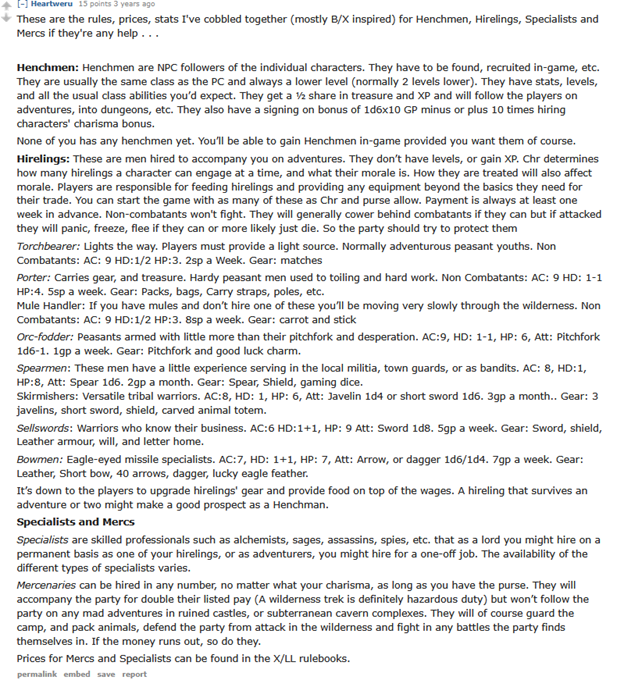
Since my method for incorporating rations depends on the use of hirelings, and players often bandy about different words to describe these characters, I want to quickly clarify my own understanding. I have found /u/Heartweru’s explanation super helpful and use their terminology. Hirelings are noncombatants who carry rations, manage torches, help with encumbrance for the party. Henchmen are sellswords who join the party on adventures for the purpose of earning treasure.
Proposed Method
In a Forbidden Lands campaign, the resource die for consumables is consulted at least once a day. That is too frequent for my taste (and frankly does not work well with my own travel method in which entry into hexes is measured by days; a description of my travel/charting system can be found here). My proposed method for measuring food only requires a rations check once a week. Moreover, instead of buying individual rations, the party tracks their rations together using one communal resource die.
Every character in the party (excluding hirelings and henchmen) needs to pay for the resource dice. I propose the following price points (I debated raising them higher, but the point is not to punish players and rations should not be overly expensive anyways):
- D6 5 SP per party member (excluding hirelings and henchmen)
- D8 10 SP (same as above)
- D10 15 SP (same as above)
- D12 20 SP (same as above)
Unlike henchmen, who demand a share of the treasure, the salaries of hirelings are factored into the cost of a ration resource die. A party does not need to hire a hireling to buy a ration resource die, but they can only use the D10 and D12 resource die if they found a hireling willing to travel with them. In my campaign, hirelings perform a morale check upon the first sign of trouble, whether traps or an encounter; henchmen are less likely to need a morale check in combat since they are seasoned veterans. If at any point all of the hirelings are killed or flee, the party loses access to the D10 and D12 resource die.
Characters need a ration resource die to heal HP and ability score loss; parties without a ration resource die will lose -1 strength and agility per week. Henchmen perform a loyalty check every day they go without food (individual roll for each sellsword). Upon a failed loyalty check they will desert, unless the party can entice them to stay a little longer with bribes. Lack of a ration resource die will never cause hirelings to abandon the party, however. After all, it’s scary out there! There is strength in numbers.
In a pinch, parties may reduce their ration die by one in an attempt to evade monsters. This will work 10% of time for intelligent monsters, 50% for semi-intelligent, 90% for non-intelligent.
If players run out of food by exhausting their D6 resource die, they can forage to stay alive. Foraging is automatic. There are no dice rolls required. Foraging, however, adds an extra day to chart or enter a hex. If a party is in a hurry, they can forgo foraging to increase their pace, but they will lose an additional -1 strength and agility per hex entered.
While exploring, parties can only recover their ration resource die by trading with merchants or individuals they encounter, finding foodstuff (e.g., in a dungeon’s larder), or eating creatures/monsters they slay. (For those of you looking for an opportunity to use the menu tables in Skerples’s The Monster Overhaul, here you go!) The DM will determine an appropriate resource die value based on the quality and quantity of food. The numerical value of this replenished resource die cannot exceed the party’s starting resource die for food; if no hirelings are currently in the party, the resource die cannot exceed d8.
When players return to town, the ration resource die automatically expires. They need to purchase a new resource die next time their characters leave town. I do this because I have a lot of rotating players, each with a stable of characters. Having the resource die expire prevents the need to harmonize any remaining rations at future sessions. The price of rations in my method is somewhat negligible for this reason. The real cost is dealing with a character’s inability to heal when their food runs out.
Parting Thoughts
In short, this method greatly simplifies the process of tracking rations while also making them matter in novel ways. The lack of food does not kill players, but it does prevent them from automatically healing. Of course, players can always skirt this and find another way to heal the party. Clerics can lay on hands or the party may use a healing potion. This is a good thing! It means that players are making active choices. Likewise, the delay caused by foraging complicates matters further by introducing time as a constraint; yet players can choose to march quickly if they are desperate to be some place. Lastly, by having the hirelings in charge of the food, it creates a tension between the use of hirelings and henchmen. A (perceived) mismanagement of food by the hirelings may cause the henchmen to lose faith in the adventure and desert.
At any rate, that’s all the wondering I’ve been up to lately. I’m keen to hear your thoughts!
Appendix
Just in case Reddit implodes, I’m screenshotting /u/Heartweru’s comments for posterity.
 The Wondering Monster
Leave a comment