This is the first of several planned posts offering advice on designing clerics and their deities.
I know that clerics often receive a bad rap in the D&D community and its OSR progeny, but I absolutely adore DCC’s take on this classic class. Clerics are my favorite DCC class largely because of the disapproval mechanic. Narrative-wise, disapproval elegantly establishes the relationship between a deity and their cleric, and ensures that the cleric remains true to their faith. Mechanically, it often forces the cleric to make tough choices. Depending on the disapproval they’ve accumulated, they need to weigh the risk of rolling within their disapproval range. As such it quickly becomes a game of pressing your luck.
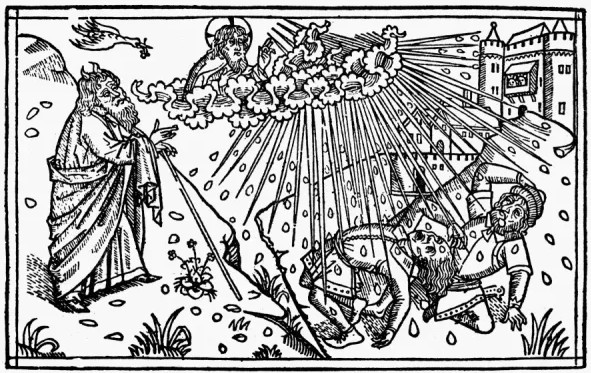
The core rulebook provides players with a generic disapproval table that they can roll on. However, I think that everyone with a homebrewed deity should try their hand at crafting a disapproval table at least once simply because it can increase immersion and fun (provided it’s done well). In this post I demystify the process and offer advice on how to create an excellent one. While many of my blog posts are meant for DMs, players should also find this post helpful.
In case anyone has stumbled upon this post and doesn’t know what disapproval is or needs a refresher, here’s a quick explanation: a cleric starts with 1 disapproval and every time they fail a spell check, they increase their disapproval range by 1. Whenever a cleric rolls a natural 1 or within their disapproval range, they roll 1d4 for every point on the failed check. For instance, if your disapproval is currently an 8 (meaning you failed 7 spell checks that day) and you fail another spell check by rolling a 6, you have to roll 6d4 and consult the result on the disapproval table. A cleric’s disapproval resets to 1 each day in game.
Common Pitfalls to Avoid
Crafting a disapproval table can feel a little overwhelming first. After all, 20 unique results are a lot—especially if one intends to make more than one custom deity. There is also a very real danger of creating a disapproval table that does not make sense or is frankly unfair. Even the Annual, which has an excellent take on deities, has some disapproval results that I consider poorly written, not fun, or unreasonable because they warp the campaign too much. I remember having a subpar experience playing as a cleric of Shul for some of these reasons.
Examples of disapproval results that I don’t like from the Annual are:
Justicia result #6: “The cleric must recite the names of all the stars and constellations she knows in the heavens. Before the recitation, the judge will give the player five seconds to estimate how many he or she knows. At the end of the recitation, the player will roll the die on the die chain closest to the number that he or she estimated. If the die roll is greater than the number of stars named, the cleric temporarily loses one point of Personality for two hours of in-game time” (21).
This could be fun once, but I think it overstays its welcome, especially since it’s a result that one will likely roll multiple times. It also blurs the line between player and character intelligence. Even more importantly, I don’t understand why Justicia, the goddess of justice and mercy, cares about stars or constellations. Apart from a mention of “starshine” in the flavor text of one lay on hands result, nothing in her entire entry makes this association.
Justicia result #10: “The cleric must run a ‘gauntlet’ comprised of the cleric’s compatriots, who strike the cleric with fists or the ‘flat’ of their weapons. The cleric must run the gauntlet as many times as it takes to successfully reach the end” (21).
I understand that this text is talking about subdual damage, but omitting the term “subdual damage” is problematic. I could see many tables interrupting their session to try to figure this out.
Malotoch result #17: “For the next week, the priest will be afflicted with a horrible disease, frightful to behold (e.g., oozing sores on the face). Any attempts to traffic with normal folk will end poorly (-5 to any rolls made as a result of interaction with NPCs) until the disease heals naturally. Any attempt to heal the disease with lay on hands will increase the length of the ailment by 1d10 days” (26).
The disease makes sense to me. The extra verbiage explaining what will happen if one uses lay on hands seems needlessly complicated. Why not say that lay on hands will not cure it? After all, if trying to heal the disease this way extends it, no one would reasonably do so. The only thing I can think of is an antagonistic party member or the DM sending waves of clerics after the diseased cleric to punish them in a non-consensual way. That’s not the type of game I want to play.
Shul result #6: “The cleric immediately incurs a -1 penalty to all lay on hands attempts. This penalty remains until the cleric removes a curse that involves the moon” (35).
This is flavorful, but it relies on the DM incorporating something like lycanthropy at some point (and, if I’m the cleric or a party member constantly getting injured, hopefully soon!). Moreover, since it’s a low disapproval result, it’s likely to happen multiple times for this character. That feels like it would unduly warp the campaign.
Shul result #20: “The cleric receives the brand of the Moonless, and suffers a -2d spell check penalty until he completes the quest of the moonchild: speak with the trees draped in moonspider’s webs; sleep on the steps of the moonpool; coax the black owl to land on a silver branch; view the new moon from Crimson Mountain’s peak” (35).
Again, nothing here is inherently problematic, but all of these very flavorful options require the campaign to adjust to the cleric and not the cleric to the campaign. And to be clear, I’m not advocating a railroad. I’m just trying to be realistic about balancing the goals of other players. Compare this with Malotoch’s result #20: “The cleric must use the Murder Hymn canticle to summon an anathaema eagle, and ride it to the peak of Tol Morda. There she must cut off her own hand and lay it upon the Altar of Bones as a sacrifice” (26). This is a harsh punishment, but it’s far easier to imagine how a cleric of Malotoch would accomplish this. It’s equally easy for the DM as well. All they need to do is determine Tol Morda’s location, and for all intents and purposes, it could be a random mountain on their map.
Untangling the Purpose of a Disapproval Table
At its heart, a disapproval table punishes a cleric and offers them an opportunity to make amends. Punishment can force the cleric to prioritize a specific task; temporarily impair their ability to use magic (whether in the form of divine favors, canticles, spells, or turn unholy); require them to commit some form of self-harm; or test their faith in some capacity. Making amends can require the cleric to acquire new converts, go on a pilgrimage, or destroy/desecrate things belonging to a rival deity, such as artifacts, relics, shrines, or temples. Sometimes the line between punishment and making amends can be blurry. Sacrifice, for instance, is a way to make amends but also a form of punishment.
Disapproval can result in the cleric taking on physical characteristics of their deity—a phenomenon I refer to as a “sacred trace.” Some disapproval tables in the Annual ask players to make a corruption roll, but I think this is a mistake because the results are random and highly unlikely to align with their deity’s ethos/domain. It also misses a perfect opportunity to make the cleric more thematically linked with their deity. Pelagia’s disapproval table on page 30 has some of the best examples of “sacred traces” in the Annual:
- Result #4: “To pay homage to the sleek creatures of the sea, the cleric is asked to remove all visible hair from her body.”
- Result #15: “It pleases Pelagia to transform the cleric’s face into that resembling more of a fish—cleric’s eyelids are removed resulting in bulbous fish eyes. Cleric incurs -3 penalty to spell checks for remainder of day.”
- Result #18: “It pleases Pelagia to transform the cleric’s face into that resembling more of a fish—non-functional gills are inserted into the cleric’s neck. In addition, cleric incurs -4 penalty to spell checks for remainder of day.”
Ideally, a disapproval table conveys something about the temperament and/or tenets of a deity. For instance, when a cleric of Cadixtat or Malotoch rolls 20+ on the disapproval table, they need to cut off their fingers or hand as a sacrifice. This makes sense given their chaotic alignment. The lawful Justicia simply prohibits their cleric from receiving any type of aid for two hours, whereas neutral Pelagia ages their cleric 1d5 years.
Balancing a Disapproval Table
When determining how punishing to make a deity’s disapproval results, I recommend balancing it with that deity’s divine favors and canticles. Compared to Cadixtat or Malotoch, the disapproval tables of Justicia and Pelagia are relatively tame. Malotoch has three divine favors, two of which—Speak with Messenger (ask a crow a question once a day) and Blessing of the Flesh (prevents the cleric from “bleeding out” at zero hit points)—are almost always helpful. Malotoch’s canticles are also quite strong. Meanwhile Justicia’s divine favors can absolve a person’s guilty conscience and clean clothes; likewise, her canticles do not strike me as overpowered. Pelagia’s divine favors and canticles are also somewhat weak, though in an aquatic campaign they could be quite helpful. Thus, crafting a disapproval table requires one to pay attention to a deity’s overall power (which is often setting dependent).
For a sense of how to balance the negative modifiers and length of punishments for each result, I recommend reading the generic table in the core rules (122-123). I think it provides excellent benchmarks in this respect. Generally speaking, the more punishing results should be placed higher on a disapproval table since they are less likely to be rolled. This arrangement ensures that players feel more anxiety when their disapproval increases. It also ensures that the cleric is not routinely punished with results that restrict them for longer than a day or warps the campaign by requiring them to accomplish an out-of-the-way quest to make amends.
Conclusion
Hopefully, this gives you a framework for making a fun, well-balanced disapproval table. If you think I’ve been too harsh in my critique of disapproval results in the Annual or believe I forgot to mention something, let me know. I’m also keen to know if there are disapproval results in the Annual that you love/hate.
In my next post I plan to review all of the deities in the DCC pantheon, as found in the Annual as well as other publications. In a few weeks I will share a deity I recently designed so you can see what a custom disapproval table might look like. Since I also plan to post a write up on canticles and divine favors, I figure it makes sense to lay the theoretical foundation before showcasing my work. Thanks for your patience.


 The Wondering Monster
Leave a comment